




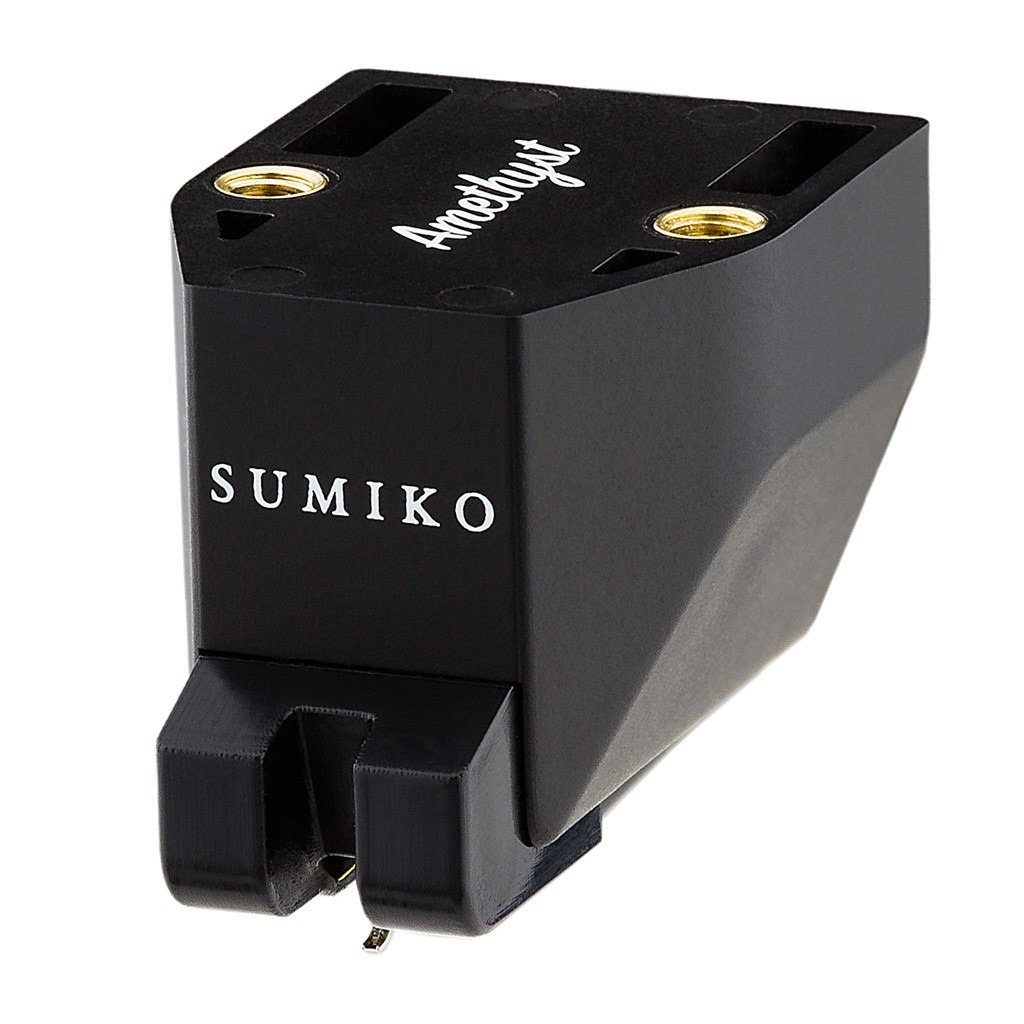
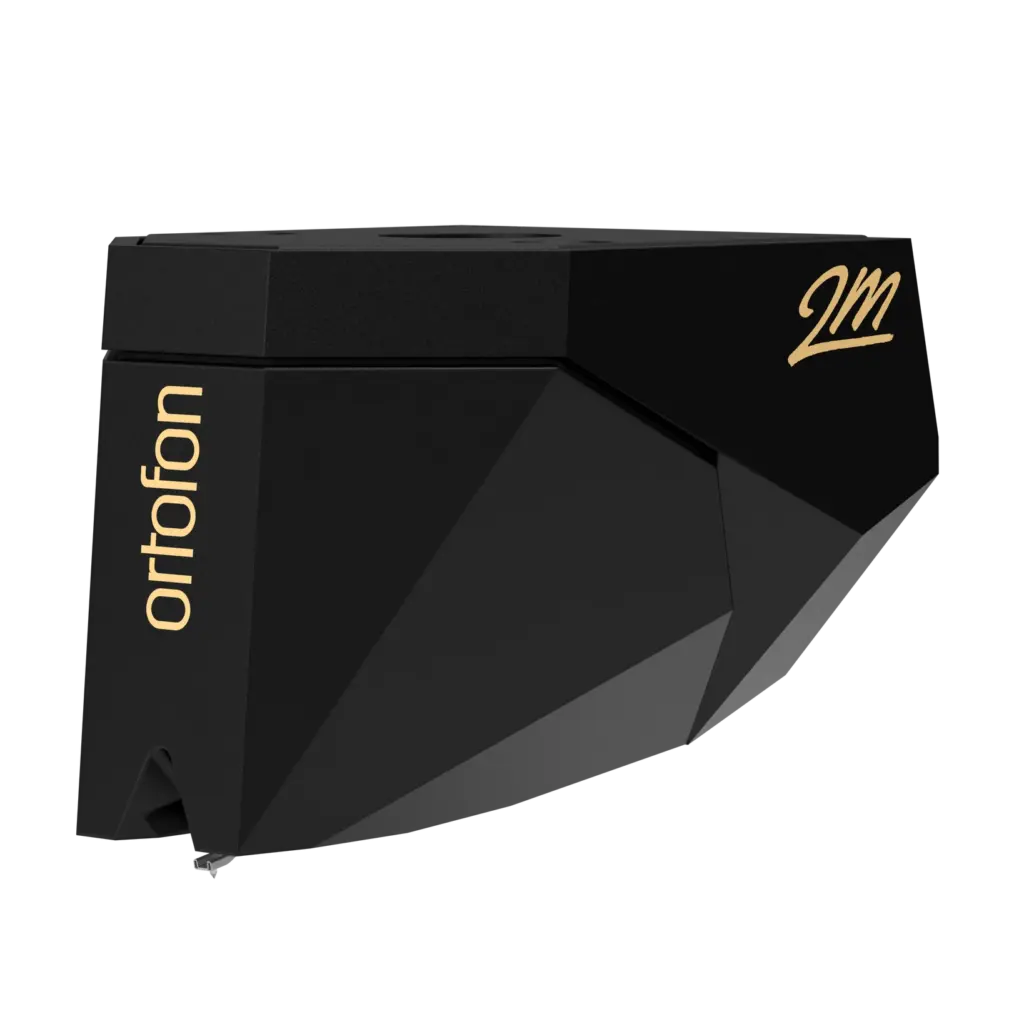
They're both moving magnet cartridges in the same price range, both with thin-profile styluses, and both designed for those who want the most from a moving magnet without having to resort to moving magnets. But the Sumiko Amethyst and the Ortofon 2M Black ask different things of your system—and on one of them, if you get it wrong, the more expensive cartridge sounds worse than a cheap one.
The difference that matters most of all: the output voltage
Before any discussion about sound, a number: the 2M Black outputs at 5 mV, the Amethyst at 2,5 mV . Exactly half.
This means that with the Amethyst, you have to raise the volume by about 6 dB to get the same level. With a generously sized, quiet phono preamp, nothing changes; with a cheap phono stage, or one integrated into an input amplifier, you risk finding yourself with the volume almost turned down and the background noise rising along with the music.
Sumiko made that choice on purpose: a lower output helps achieve the "black background" typical of MCs. It's a real advantage, but you can only enjoy it if the phono stage is up to par . If your phono stage is the one included with the amplifier and you're not sure how much gain it has, the 2M Black is the choice that won't put you in trouble.
The comparison of the data
| Sumiko Amethyst | Ortofon 2M Black | |
|---|---|---|
| Type | MM | MM |
| Output voltage | 2,5 mV | 5 mV |
| Thumbtack | Line-Contact bare 0,2 × 0,8 mil | Shibata naked, advanced elliptical |
| cantilever | aluminum tube ⌀ 0,5 mm | High-stiffness Lexan DMX |
| Coils | high purity copper | silver-plated copper |
| Reading strength | 2,0 gr (1,8 - 2,2) | 1,5 g (1,3 – 1,7) |
| Load capacity | 100 - 200 pF | 150 - 300 pF |
| Load impedance | 47 kW | 47 kW |
| Channel separation | 30 dB | undeclared |
| Weight | 6,5 gr | 7,2 gr |
| Recommended arm mass | undeclared | 8 - 18 g |
| Origin | Japan | Denmark |
The second trap: carrying capacity
This is the figure that almost no one looks at and which audibly changes the sound on MMs , unlike many more advertised figures. The Amethyst requires 100-200 pF , the 2M Black 150-300 pF.
The value reaching the cartridge is the sum of the capacitance of the tonearm cable, the cable to the amplifier, and the phono input. A long or high-capacitance cable can easily take you above 200 pF: in that case, the 2M Black is still in the window and the Amethyst is not, and the result is a high range that brightens unnaturally.
Translated into practice: the Amethyst has the narrowest and lowest window . If your phono allows you to choose the capacitive load, you can make it work best; if it's fixed and you don't know how much it's loaded, the 2M Black is more forgiving.
Stylus, cantilever and reading force
Both use a thin-profile naked diamond—the Sumiko uses a Line-Contact, the Ortofon a Shibata—which is the type that reads the top of the groove more accurately than an elliptical, with two consequences: more detail and, if the alignment is rough, more severe mounting errors. With neither, you can afford to set up by eye.
The cantilever options diverge: aluminum tubing for the Amethyst, high-rigidity plastic (Lexan DMX) for the 2M Black. These are two different construction philosophies, and there's no single best one.
Finally, the tracking force: 2,0 grams versus 1,5 . Half a gram may not seem like much, but it's a third more weight on the groove. If your tonearm is light, or if you use a cheap scale costing just a few euros, you have less margin for error with the Amethyst. The 2M Black also states the recommended effective tonearm mass, 8-18 grams, which covers the vast majority of tonearms on the market: an additional figure to know in advance if it will be compatible with your turntable.
Which one to choose
- Ortofon 2M Black If your phono is the one built into the amplifier or an input stage, if you don't know the capacitance of your cable, if your tonearm is medium mass and you want the safest route. It's the cartridge that demands the least from the rest of the system.
- Sumiko Amethyst If you have a dedicated, quiet, and high-gain phono preamp, it's best to use an adjustable capacitive load. In those conditions, the lower output provides a quieter bottom end, which is exactly what it's designed for.
The question to ask isn't which of the two sounds better: it's which of the two your phono cartridge can make sound good . This reversal applies to all cartridges in this range, and explains why so many upgrades to a more expensive cartridge are disappointing.
You'll find both among cartridges and tonearms , along with alternatives from other brands. If you tell us the make and model of your turntable, tonearm, and phono stage, we'll tell you which one makes sense for your system—and if by chance it's better to spend that money on the phono stage rather than the cartridge, we'll tell you anyway.