




Description
Features:
CONTINUOUS OUTPUT POWER, PER CHANNEL, 8Ω:
2 channels driven, 110 wpc - 20Hz-20kHz, <0,02% THD
2 channels driven, 125 wpc - 1kHz, 0,2% THD
7 channels driven, 90 wpc - 1kHz, 0,2% THD
Residual noise and hum (A-weighted) - <0,15 mV
AUDIO PERFORMANCE (STEREO LINE INPUTS):
Signal to noise ratio (modali(A-weighted, stereo-direct) - 110 dB
Frequency response - 20 Hz-20 kHz ± 0,1 dB
VIDEO INPUTS:
HDMI - x7 (6 x HDMI 2.0a, HDCP 2.2, 1 x MHL compatible)
VIDEO OUTPUTS:
HDMI - Z1 x2 (out1 ARC, HDMI 2.0a, HDCP 2.2, out2 HDMI 2.0a, HDCP 2.2), Z2 x1 (HDMI 2.0a, HDCP 2.2)
AUDIO INPUTS:
HDMI - x7, SPDIF Coaxial - x4, Toslink - x2, RCA Phono - x6,
3,5mm aux, USB input, Ethernet client, internet radio, ARC (from display)
AUDIO OUTPUTS:
7.1.4 Preamp Output - 12x RCA Zone 2 Output - RCA
RADIO TUNER:
FM / DAB / DAB+ (in appropriate markets)
THE MODALISUPPORTED SURROUND SOUNDS INCLUDE:
Dolby Atmos, Dolby Surround, DTS:X, DTS-HD Master Audio, DTS-ES 6.1 Discrete, DTS-ES 6.1 Matrix, DTS 5.1, DTS Neural:X
GENERAL:
Trigger 12V x2 IR in x2 6V rSeries PSU x1
Energy consumption (max) - 1,5kW (approx. 5200 BTU/hr)
Power consumption (standby) - < 0,5 W
DIMENSIONS AND WEIGHTS:
Width = 433 mm (~17 inches)
Depth including speaker terminals = 425 mm (~16,7 inches)
Height including feet = 171 mm (6,75 inches)
Weight (net) - 15,5 kg (~34,2 lbs)
Weight (packaged) - 18,8 kg (~41,5 lbs)
Description :
From the official website translated with Google:
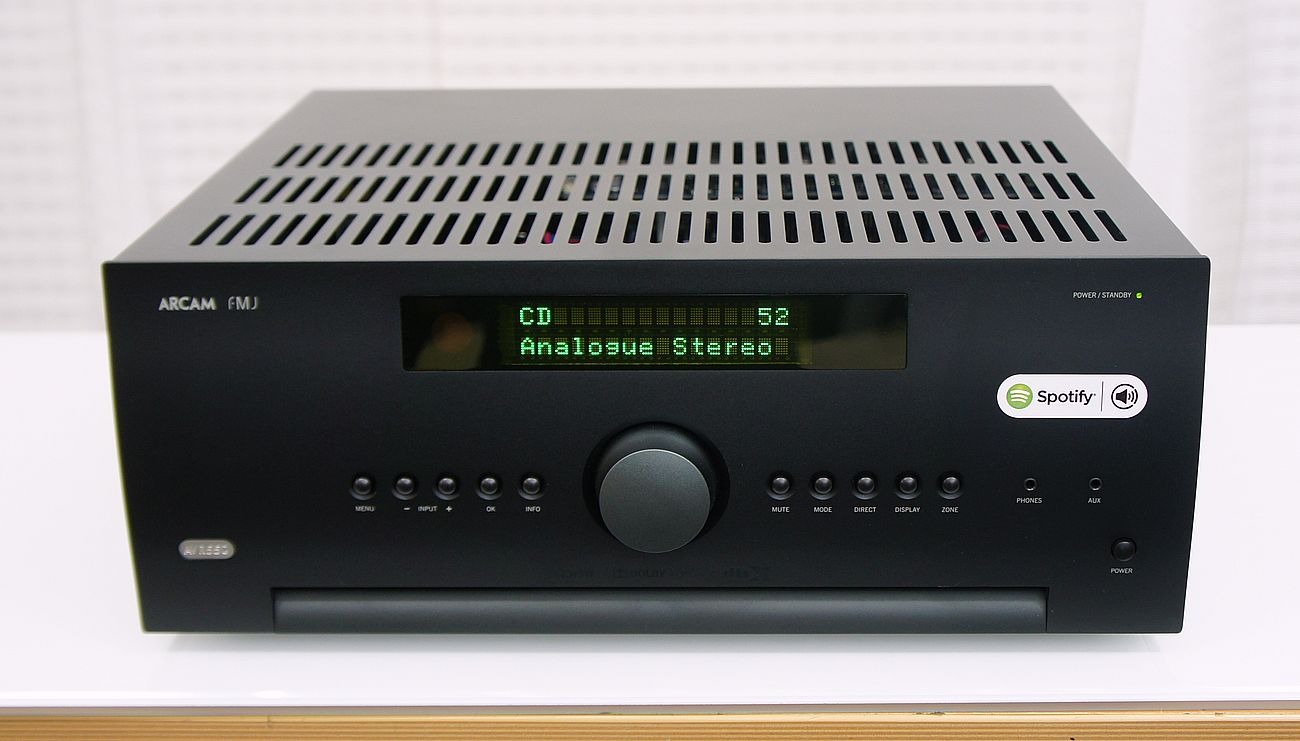
As one of the very few audio specialists in the world designing AV receivers, Arcam has developed a reputation for balancing finely honed specifications with world-class audio performance. The AVR390, AVR550, and AVR850 are, quite simply, the best-performing AV receivers Arcam has ever made.
Dolby Atmos & DTS: X 7.1.4 decoding
4K (UHD) HDMI2.0a with HDCP2.2
7 HDMI inputs, 3 HDMI outputs, ARC compatible
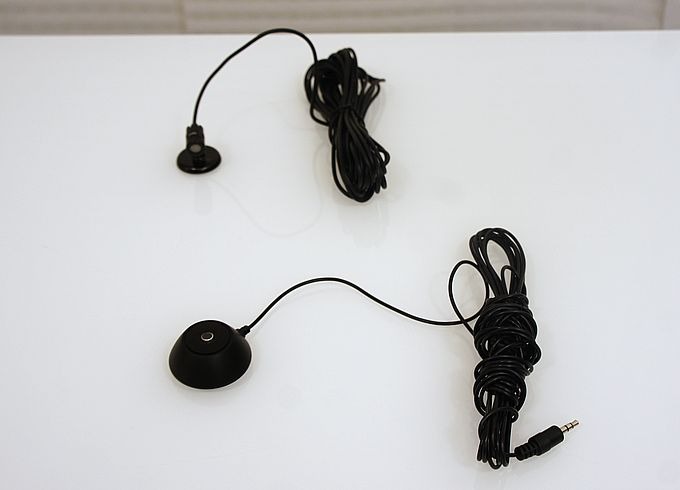
Dirac Live® for Arcam camera correction
Spotify® Connect enabled
Cirrus CS42528 audiophile DAC
Class G power amplification (AVR850 only)
Ethernet, RS232 and IR control
MusicLife iOS UPnP and control app
Offering a level of sound quality that is far above competing receivers, these AVRs are audiophile products by any measure. Equally at home with high-resolution surround sound or two-channel music, they deliver stunning realism with everything from top-tier blockbusters to your favorite concert video.
Further enhancing the performance of the new AVR390, AVR550, and AVR850, Arcam has also included the latest room correction technology from Dirac Research. Dirac Live® for Arcam gives dealers the ability to fine-tune the system's acoustic performance to any room situation, providing listeners with the best possible experience in their own home.
Combined with Arcam's legendary amplifier technology, Dolby Atmos and DTS:X deliver captivating sound that places and moves audio anywhere in the room, including overhead, to bring entertainment alive for the entire audience. Whether you're listening to music, movies, TV shows, or playing your favorite video games, Dolby Atmos and DTS:X deliver the full impact of the entertainment experience. Note: For a 7.1.4 system, an additional 4-channel amplifier (or two 2-channel power amplifiers) is required.
Both the video and audio stages are designed to embrace current and future technologies. HDMI 2.0a with HDCP 2.2 4K "Ultra HD" and 3D video capabilities are integrated. An internal tuner provides a fully integrated FM/DAB/DAB+ radio solution (in appropriate markets). Worldwide access to internet radio stations is provided through the network connection, which also interfaces with UPnP audio servers. The USB port supports memory devices.
Control is possible via Ethernet, allowing for full integration with whole-home control systems, or via the MusicLife UPnP/control app for iOS. RS232, 12V triggers, and standard IR control are also included. The AVR390, AVR550, and AVR850 are designed in the UK.
Dirac correction Live room
How it sounds:
From the site below translated with Google:
https://www.hifi.nl/artikel/25999/Review-Arcam-AVR550,-een-mooi-geheel.html
Arcam also makes a limited line of high-end AV receivers that are also great for music lovers. This has to do with the brand's philosophy. Arcam tunes its AV receivers for music, claiming that if a receiver displays a piano or drums well, it will probably do well with exploding houses and transforming robots. There's something to be said for that.
Arcam's latest generation of AV receivers also feature a full Dirac implementation, which we find very impressive. Arcam currently offers four Dirac-enabled AV receivers: the SR250 (a two-channel receiver with HDMI inputs), the AVR390 (7,1, 7 x 75 watts), the AVR550 (7,1, 7 x 90 watts), and the AVR850 (7.1, 7 x 100 watts). There's also the AVR860—no receiver, but an 11.1-channel surround processor. In this review, we're looking at the AVR550, unfortunately without Class G, but with Dolby Atmos and DTS:X support.
Features first
If you look at the entire Arcam AV receiver lineup in person, you'll notice one thing: they look very similar. Even the specs don't differ dramatically, despite the notable price differences when upgrading from one model to the next. In that case, you're almost exclusively paying for better audio, so the AVR850 is a serious upgrade. Only this model features Class G final gain.
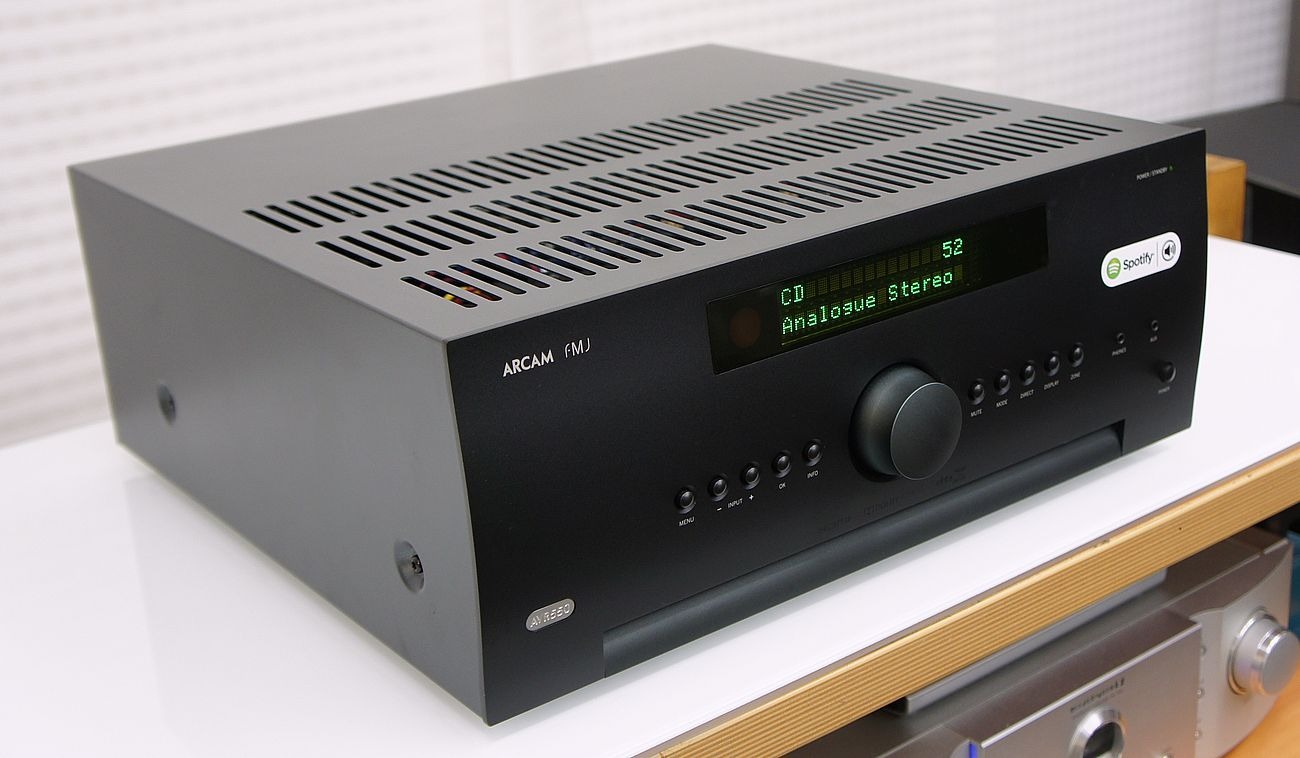
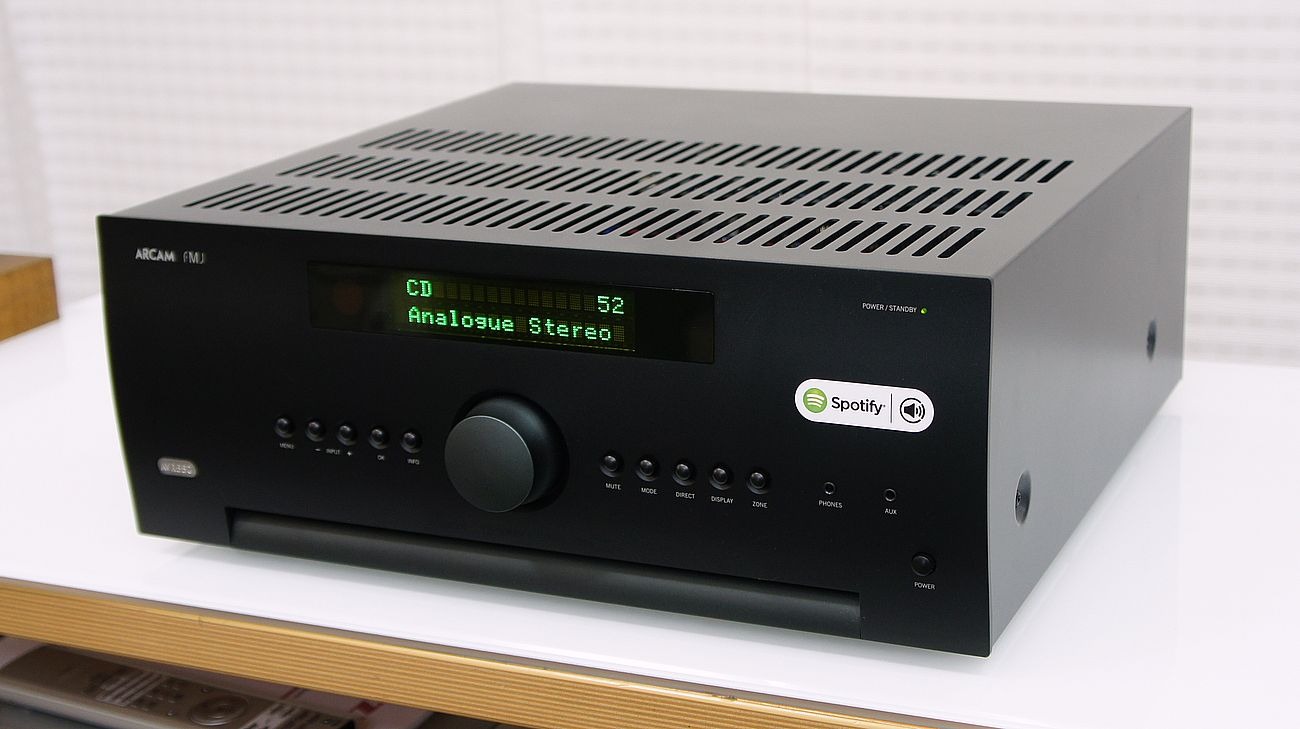
We'll be honest: we don't find the AVR550 design very exciting. It's a fairly functional look, designed to hide in a hi-fi cabinet. The business look can be a little daunting, but if you pick it up, you'll feel the weight. The AVR550 we tested weighed nearly 20 pounds.
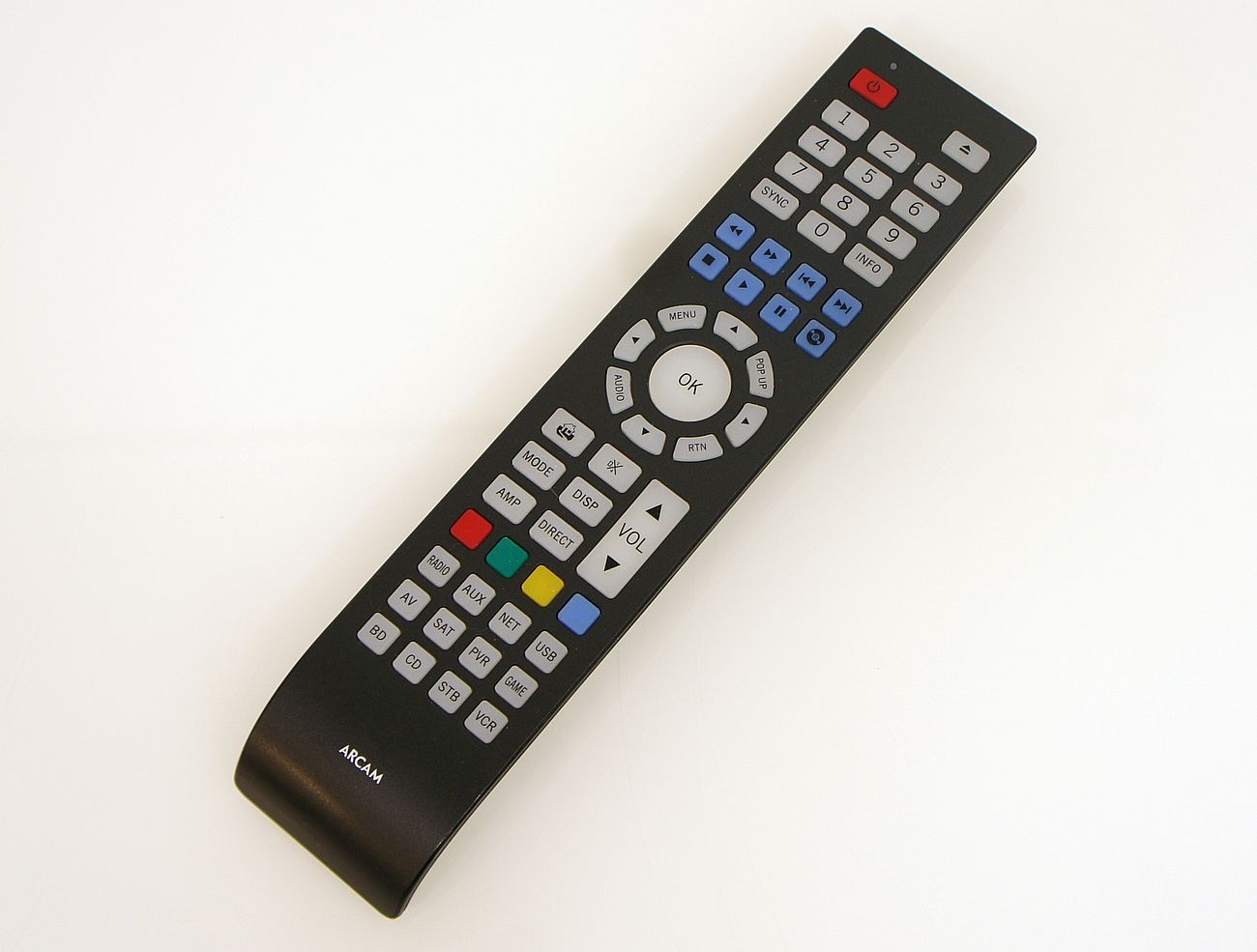
And we must emphasize that functional design doesn't mean poor build quality. The AVR550 feels very solid and heavy—did we mention that? The green display is old-school, but at the same time, the materials used and the very solid finish convey a certain reassurance. The AVR550 is controlled via an equally functional remote control or via two apps. On the front, you'll find a relatively limited number of buttons and a large volume button. Unlike many other AV receivers, there's no hidden key. What you see is what you get.
You are likely to get the Arcam apps then. There are two. Arcam Control is the direct replacement for physical remote control. In appearance it is just as elegant and simple as the devices themselves, but it is very useful. It's handy that you can quickly adjust things like the sub level.
The second app is called Arcam MusicLife and is primarily used to select music played over DLNA. Again, no unnecessary frills, just an app that gets the job done quickly and easily. We also used the same app for testing Solo Music and Solo Movie, so we know you can also control certain music services (like Qobuz) through MusicLife. Unfortunately, this feature doesn't work with the AVR550, and you shouldn't expect AirPlay or Bluetooth. The AVR550 isn't teeming with streaming options, especially when compared to what Yamaha and Onkyo offer. Aside from DLNA, the only thing you can count on is Spotify Connect. It's worth noting that the Android app uBubbleUPnP allows you to stream high-quality Tidal and Qobuz streams over DLNA to the Arcam receiver. You can already get that app for a few euros.
It won't surprise you that the TV interface isn't a visual feast. No, it looks as professional as possible. In this case, the interface simply means "settings," because there's no real main menu where, for example, the various inputs are graphically represented. Sony, for example, does a good job of doing this. Since this is a serious home theater device and can be installed by a professional, you shouldn't expect a detailed DIY setup plan like with Denon.
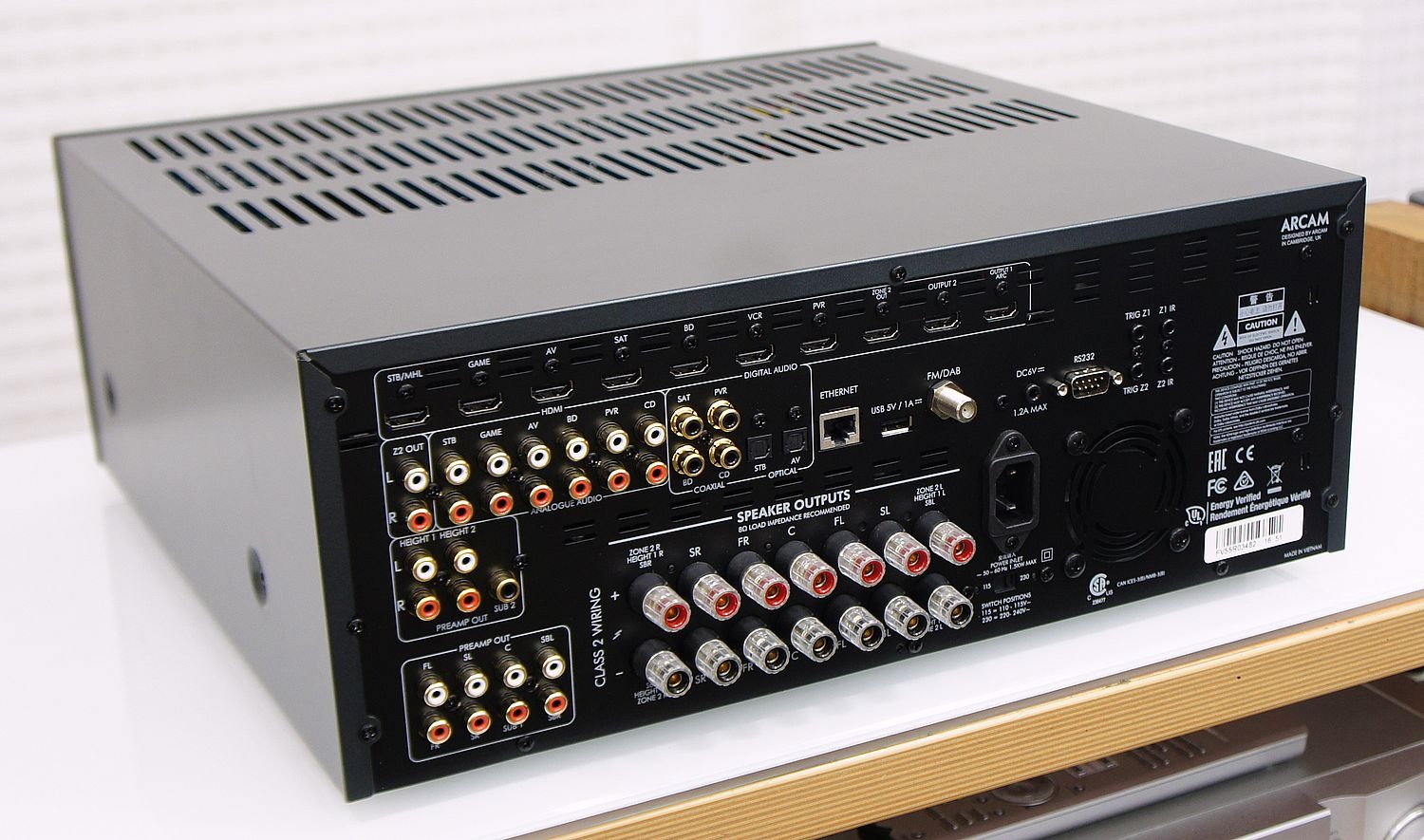
However, the settings are extremely extensive and really have everything you need. The same is true for connections. The AVR550 is designed for home automation environments, via IP or RS232, for example. You can count on seven HDMI inputs, four coaxial inputs, two optical connections, six analog inputs, a USB port, and a 3,5mm jack. Since Arcam also likes to see this receiver appear in a large, high-end cinema, there are no fewer than twelve pre-outs. You can therefore use the AVR550 as a pure AV processor and leave the amplification to powerful power amps, like the €4.500 P49. Remember: you'll need more than one of these stereo champions...
There are also three HMDI outputs, divided into two separate zones. All HDMI connections are HDMI2.0a and HDCP 2.2 compliant.
Questo è tutto
If you read the above, you might want to remove the AVR550 from your list of receivers to review. But wait, what this device lacks in sensuality, it makes up for with plenty of power and very strong room correction. Its main asset is undoubtedly the implementation of Dirac Live, which goes far beyond a traditional calibration system. The results are much more impressive, as you can read about them in our background article on Dirac. You're definitely getting used to it, especially if you're actually doing a 7.1 or 5.1.2 setup. The more channels, the longer the measurement will take. Unlike most calibration systems, you need to perform a measurement at seven positions, and you do this via a laptop.
The nice thing is that after the measurement, you'll be offered a suggested correct frequency curve that you can adjust to your heart's content. This is highly recommended. Dirac strives for a neutral representation and tends to suppress the interesting sparkle in the representation of details. That's why you should intervene: adjust the curve slightly, send it to the receiver, and then listen. Not right? Then go back to the measurement result and adjust again. For those who enjoy working with sound, it's a fun activity. A tip: make small adjustments. A frequency range of one dB plus or minus has a big impact.
There's also a downside. Dirac offers excellent results in a fairly user-friendly way—compared to a whole host of other professional solutions. However, it's still a time-consuming process to implement. Furthermore, it delivers the best results if you tweak the settings slightly, which requires both knowledge and time. You'll need to optimize five times, depending on your experience. This can easily waste hours. After all, you want to hear the result after each adjustment, which means re-installing the Dirac filters on the AVR550. It's not difficult—the app on your PC does it for you—but it takes a few minutes to set up a 5.1 or higher setup. You can only set up one filter on the receiver at a time and activate it per input as desired. For example, when listening to music, you can only work with untuned stereo speakers. Of course, you can have this done for you by a hi-fi specialist.
Let's talk about power. Arcam specifies 90 watts of power—powered by each of the seven channels. This is a significant difference from many other manufacturers, who typically list 200 watts, but don't mention that this power is achieved with just one channel loaded. Of course, not everyone needs a lot of power, but more is better for home theater purposes.
We were really looking forward to playing "Blade Runner: The Final Cut," just released on 4K Ultra HD Blu-ray with a Dolby Atmos soundtrack, on the AVR550. The receiver was connected to a set of speakers Monitor Audio Silver (2 x Silver 200, 2 x Silver 50, and a Silver C150 center), both supplied by the Belgian importer of both brands (Transtel-Sabima), with a Bowers & Wilkins DB2D subwoofer (with room correction already activated). Everyone's seen Ridley Scott's classic a dozen times now, but this final version (well, let's see, this is already version 7) is as spectacular as ever. The fantastic soundtrack, featuring music by Vangelis, plays a huge role in this, as does the innovative graphics, which cast a dark vision of the future.
It's also a film with a wealth of dynamics. Introspective silences (which in the less beautiful Hollywood version were filled with a voiceover from a bored Harrison Ford) alternate with Vangelis's powerful sound effects. Ridley Scott wanted to convey the impression that futuristic Los Angeles was abandoned, but that some places were very busy. This is also reflected in the sound design. The scenes with crowds of people walking through the rain—with glowing umbrellas—are familiar, but notice how much detail you hear in that moment. Raindrops, Asian shouts in the background, passing vehicles, bicycle bells... there's a lot going on. The combination of power and Dirac allows the AVR550 to display all of this very accurately. The Silvers we're testing are relatively inexpensive speakers, but with this receiver they shave a lot off the top.
Even with the 4K version of "Ghost in the Shell," starring Scarlett Johansson, we note that the sound placement is extremely good. The film wasn't well-received, certainly not by fans of the original anime. And that's not entirely unjustified, as the story lacks the depth that the Japanese original had so strongly. Visually, however, it's a marvel, and Clint Mansell's score—you might know him from the blissfully repetitive "Moon" soundtrack—carries the film along perfectly. Arcam's musical focus is also paying off.
close
The Arcam AVR550 is one of the most competent and powerful receivers we've ever tested. At the same time, it's one of the simplest AV receivers, especially when you consider the rest of the package. Streaming is minimalist, the interface is nothing more than a list of settings, and you won't fall in love with its looks. Plus, it packs a punch and a calibration system that makes even budget speakers stand out. Who needs more?
https://hometheaterhifi.com/reviews/receiver-processor/arcam-avr550-av-receiver-review/
Specifications
| Amplification type | class AB |
|---|---|
| RMS power per channel | 90 W |
| Reference load | 8 ohm |
| Analog inputs | RCA Phono x6, aux 3.5mm |
| Harmonic Distortion (THD) | 0.2% |
| Rapporto S/N | 110 dB |
| Frequency response | 20-20000 |
| Digital inputs | HDMI x7, SPDIF coaxial x4, Toslink x2, USB, Ethernet |
| Integrated DAC | Cirrus CS42528 |
| Dimensioni | W 43,3 × H 17,1 × D 42,5 cm |
| Weight | 15,5 kg |
| Electricity consumption | 1500 W |
| country of origin | UK |
| Integrated streaming | Spotify Connect, DLNA, internet radio |
About the brand
Arcam is one of the most prestigious British high-fidelity audio electronics brands, founded in 1976 in Cambridge, England, by John Dawson and Chris Evans, then engineering students at Cambridge University. Originally named Amplification & Recording Cambridge, later shortened to A&R Cambridge and finally to Arcam (stylized as ARCAM on products), the company has established itself over five decades as an international benchmark in the hi-fi sector, offering mid- to high-end equipment characterized by understated musicality, rigorous construction, and excellent value for money. Since July 2017, Arcam has been part of the Harman Luxury Audio group, a division of Samsung Electronics, a partnership that has further strengthened the Cambridgeshire brand's research and development capabilities while maintaining its in-house design in the UK.
Arcam's history is one of constant innovation at the service of music. The brand's first product, the A60 integrated amplifier launched in 1976, quickly became an icon of British hi-fi thanks to its understated aesthetic and surprising sonic performance for the price range. In 1986, Arcam made history by introducing the Delta 70, the first CD player entirely designed and built in the UK, immediately establishing itself as a pioneer of digital audio playback at home. In the 1980s and 1990s, the Alpha, Delta and FMJ (Full Metal Jacket, later reinterpreted as Faithful Musical Joy) series won over entire generations of audiophiles, accompanied by significant technological firsts such as the first commercial home DAC (the famous Black Box), the first home DAB tuner (the Alpha 10) and the only British cassette deck to feature Dolby S (the Delta 100 in 1992).
Arcam's design philosophy can be summed up in a phrase its engineers repeat like a mantra: make the music sound right, and everything else will follow. This principle translates into a rigorous engineering approach, focused on the quality of reproduction rather than chasing theoretical specifications, and has guided the development of every Arcam series, from traditional separates to modern streaming amplifiers and multichannel AV processors dedicated to reference home theater systems.
Arcam's signature technologies include Class G amplification, a proprietary architecture now in its fifth generation that combines the efficiency of digital with the linearity of Class A/B through dynamic switching of the power rails. The result is greater headroom, lower heat dissipation, and superior control over the speaker, especially during complex musical peaks. Other proprietary innovations include Dirac Live room correction, as implemented on high-end AV receivers, Matrix Channel Assignment technology for flexible multi-channel configurations, and AEQ (anechoic EQ), which automatically optimizes the amplifier's output to match the paired speaker. Arcam's new transducers use MCC (Micro Ceramic Composite) cones and DCC (Deep Ceramic Composite) midrange drivers with aluminum dome tweeters on an Acoustic Lens waveguide, developed in synergy with sister brand Revel.
Arcam's current range covers every need of the modern audiophile. The Radia+ series represents the heart of stereo hi-fi production and includes three transistor integrated amplifiers: the A5+ (50W per channel in Class A/B), the A15+ (80W per channel in Class A/B with moving magnet phono stage) and the flagship A25+ (100W per channel in Class G with integrated streamer, HDMI eARC input, USB-C and MM/MC phono stage). Anyone wishing to explore the finest transistor integrated amplifiers on the British scene will find this series an absolute reference. For more ambitious systems, the PA240 power amplifier is available, a 380W per channel Class G unit that is among the most dynamic and musical power amplifiers in its category, which can be found in the dedicated section. Pre-amp and power amplifier combinations based on the PA240 combined with an AVP45 processor represent a reference solution for those seeking maximum separation of the amplifier sections.
On the source front, the CD5 player inherits nearly forty years of Arcam's optical disc heritage and is an attractive proposition in the CD/SACD/DVD player category. The ST5 streamer and the compact Solo Uno offer high-resolution network solutions compatible with major streaming services, alongside other digital and analogue sources. The recent Radia Speaker series, launched in 2026 to celebrate the brand's fiftieth anniversary, marks Arcam's return to the world of transducers: the range includes two bookshelf speaker models, the 5,25-inch R15 and the 6,5-inch R25, available in their own category, and two three-way floorstanders, the R35 and the flagship R45 with a dedicated DCC midrange driver, visible in. The series is completed by the R35C center channel and the R25B 750W active subwoofer. For home cinema, the Radia line of AV receivers includes the AVR11, AVR21 and AVR31 with up to 16-channel processing, Dolby Atmos, DTS:X, Auro-3D, IMAX Enhanced and HDMI 2.1 with 8K passthrough.
Acclaim from the audio press confirms the brand's prestige. The Radia A5 integrated amplifier won the prestigious What Hi-Fi? Award with a five-star rating, Stereophile described the A25's sound as enveloping and richly musical, while Italian publications such as Audio Review, Suono, and Fedeltà del Suono have repeatedly praised the design consistency of the entire range. Arcam AV receivers are regularly included in rankings of the best high-end receivers by leading European magazines, thanks to the integration of audiophile amplification and cutting-edge video processing.
Arcam's target audience is the advanced audiophile looking for a high-end stereo or home theater system without reaching the extremes of esoteric high-end. Prices for Arcam audio electronics start at around €1.200 for the Radia A5+ integrated amplifier and rise up to €7.000-8.000 for the flagship AV processors, thus covering the entire premium segment with a competitive positioning compared to historic competitors such as Naim. Linn, NAD, Cambridge Audio and Audiolab.
For decades, Arcam's Italian distribution has been entrusted to Audiogamma SpA, a historic importer based in Monza. The company boasts a widespread network of specialized dealers throughout the peninsula, from Lombardy and Veneto to Sicily and Campania, and provides qualified technical assistance through its authorized service center. All Arcam products distributed in Italy come with an official warranty, documentation in Italian, and a dedicated after-sales support network for audiophiles and professional installers.
FAQ
This product is in the Archive section and is no longer available for sale. Visit our catalog to discover current models or contact us for personalized advice on a similar product.
When a model goes out of production, is sold permanently, or is no longer available from our suppliers, we move it to the Archive section. We maintain the page online for informational purposes: users and collectors can continue to consult specifications, descriptions, and reference images.
Probably. Visit our product catalog to discover equivalent models currently on sale: you can filter by category, brand, and price range to find the best alternative for your system.
We do not carry used or vintage products. To discover currently available alternatives, click the "Go to catalog" button at the top right of the page, or go directly to our product catalog to browse the models for sale.
We do not directly handle technical assistance or spare parts. On our support page , you'll find tables with direct contact information for service centers and specialized repairers: you can contact them directly to discuss repairs or spare parts availability.
It might interest you
-
Nuovo

-