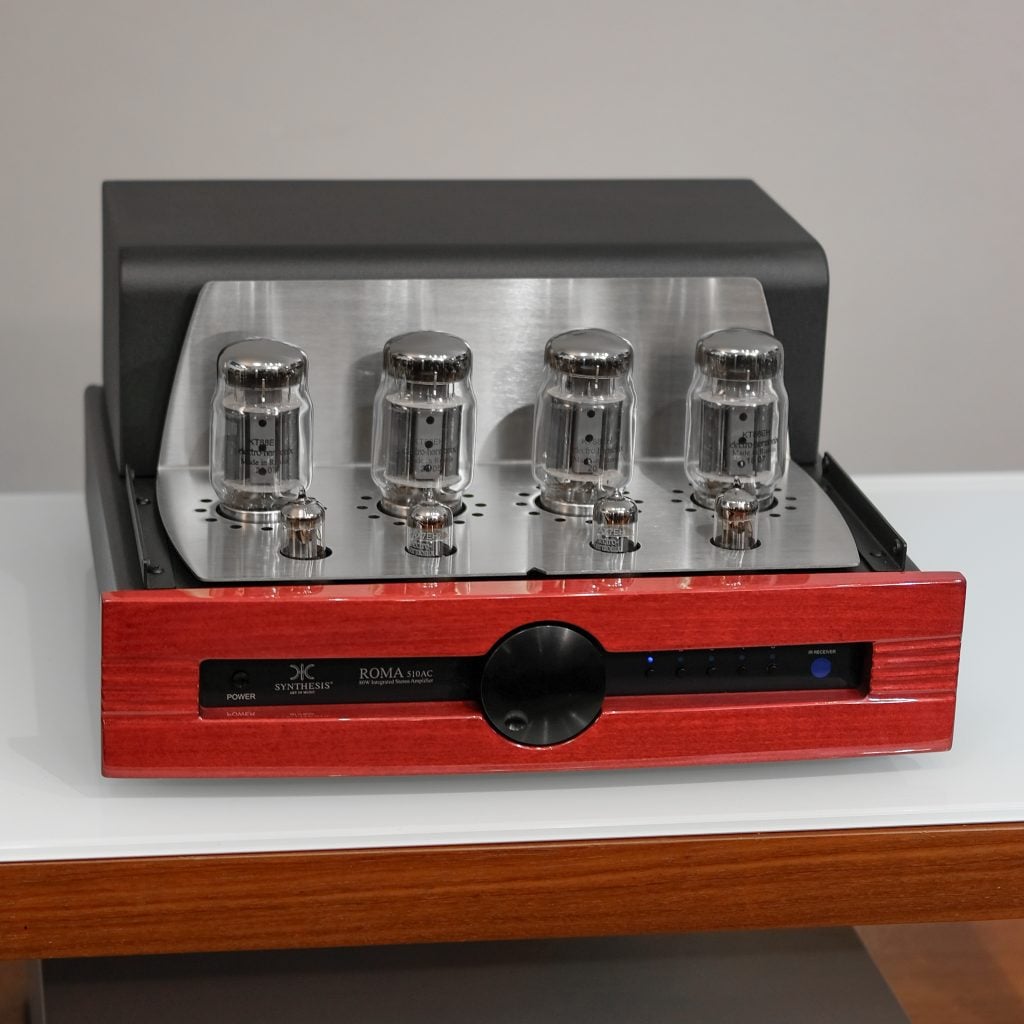






Descrizione
Dal sito:
http://www.thevintageknob.org/LUXMAN/LV105/LV105.html
Voltage driven from input to output, the LV-105 is centered around two 6CG7A twin-triode vacuum tubes.in the driver stage. Power output is delivered by high-current MOS-FET transistors. Duo-ßeta circuitry allows for a 14 octaves linearity : from DC to 200kHz.
Along select FETs in the first stages, the STAR circuit topology groups ground lines, power and signal patterns by the amount of current instead of location - the electrons thus flow more naturally and efficiently.
Two power transformers are used : one high-flux core feeds the audio circuitry while the other deals with the video circuitry, the 6CG7A tubes. Primary and secondary windings on both trafos are properly phased in.
The tubes pre-heating system operates plates at less than 50% of their voltage with the heater itself set at 80% of its voltage.
Video circuitry is present (in composite - there was no S-VHS in 1984), along tape dubbing, rec-out selectors and high quality phoo MM or MC cartridge stages.
The overall build quality is however somewhat "industrial" and not too well matched to the ingenious hybrid circuit...
The BRID (hybrid...) series was a fair attempt at (re)gaining a little bit of warmth in the middle of a "black" decade. And a good idea that many "smaller" manufacturers took on but which, paradoxically, didn't do much for LUX who was -under the Alpine impulse- striving to regain some of its mid 1970s success.
The long production run of the series, however, shows that if the Brid units didn't make LUX a bestselling brand, it helped keep that glorious name fairly in sight until the early/mid 90s... The 1984/85 introduction of the LV-104 was received with a "Good Design" award from the japanese industry. The LV-107U was a late (too late?) addition to the series and is, unlike the smaller siblings, rather rare. The same fate befell the equivalent CD player : D-107u.
Depending on the market, the LUXMAN logo was preceded by the ALPINE logo. Argh.
Specifiche
| Tipologia amplificazione | ibrido |
|---|---|
| Valvole utilizzate | 6CG7A |
| Potenza RMS per canale | 105 W |
| Carico di riferimento | 6 ohm |
| Stadio phono | MM+MC |
| Ingressi analogici | Phono MM, Phono MC, CD, Tuner, AUX |
| Distorsione armonica (THD) | 0.008 % |
| Risposta in frequenza | 1Hz - 200kHz |
| Rapporto S/N | 110 dB |
| Sensibilità ingresso linea | 2.5mV (Phono MM), 125µV (Phono MC), 150mV (CD/Tuner/AUX) |
| Impedenza ingresso | 47kohm (Phono MM), 100ohm (Phono MC), 40kohm (CD/Tuner/AUX) |
| Impedenza carico phono | 47 (MM), 100 (MC) Ω |
| Alimentazione | AC 100V, 50Hz/60Hz |
| Dimensioni | L 43,8 × A 14,8 × P 34,6 cm |
| Peso | 10,6 kg |
| Anno produzione | 1984 |
| Paese di origine | Giappone |
Sul marchio
Luxman è uno dei marchi storici dell'alta fedeltà giapponese: nacque nel giugno 1925 a Osaka come reparto apparecchi radio del negozio di cornici Kinsuido, proprio nell'anno in cui in Giappone iniziavano le trasmissioni radiofoniche. Il marchio si colloca nella fascia alta del mercato hi-fi ed è noto per la qualità costruttiva delle sue elettroniche.
Inizialmente l'azienda importava apparecchi e componenti radio; ben presto decise di produrre internamente componenti come trasformatori e commutatori, scelta da cui nacque il marchio Luxman. La filosofia sonora punta a un equilibrio tonale naturale, che non alteri il messaggio musicale originale.
Tra le tecnologie distintive c'è il circuito ODNF (Only Distortion Negative Feedback), che applica la controreazione alle sole componenti di distorsione del segnale ed è arrivato alla versione 4.0. Il più recente LIFES (Luxman Integrated Feedback Engine System) equipaggia gli apparecchi di ultima generazione, come l'integrato L-509Z (versione 1.0) e l'L-100 CENTENNIAL (versione 1.1). L'attenuatore LECUA (Luxman Electronically Controlled Ultimate Attenuator) regola il volume a passi, fino a 88, con resistenze fisse commutate elettronicamente, evitando i limiti dei potenziometri tradizionali; sull'L-509Z è presente nella versione LECUA-EX. I lettori digitali utilizzano la meccanica proprietaria LxDTM.
La gamma Luxman copre l'intera catena hi-fi: amplificatori integrati a transistor della serie Z (L-505Z, L-507Z e L-509Z, quest'ultimo da 120 watt per canale su 8 ohm); il preamplificatore C-10X e il finale M-10X; elettroniche a valvole come il preamplificatore CL-38uC, il finale MQ-88uC e l'integrato SQ-N150; lettori digitali come D-03R e D-07X, il convertitore DA-07X e lo streamer NT-07; preamplificatori phono (E-250, E-07), testine e i giradischi PD-151 MARK II e PD-191A, quest'ultimo a trazione a cinghia con motore DC brushless e braccio LTA-710 da 10 pollici.
Per il centenario Luxman ha presentato la serie CENTENNIAL: l'amplificatore integrato in classe A L-100, il lettore SACD/CD D-100, l'amplificatore per cuffie P-100 e il finale monofonico B-100.
Domande Frequenti
Questo prodotto si trova nella sezione Archivio, quindi non è più disponibile alla vendita. Visita il nostro catalogo per scoprire i modelli attuali oppure scrivici per ricevere consigli personalizzati su un prodotto equivalente.
Quando un modello esce di produzione, viene venduto definitivamente o non è più reperibile dai nostri fornitori, lo spostiamo nella sezione Archivio. Manteniamo la pagina online a scopo informativo: utenti e collezionisti possono continuare a consultare specifiche, descrizioni e immagini di riferimento.
Probabilmente sì. Visita il nostro catalogo prodotti per scoprire i modelli equivalenti attualmente in vendita: potrai filtrare per categoria, marca e fascia di prezzo per trovare l'alternativa più adatta al tuo impianto.
Non gestiamo prodotti usati o vintage. Per scoprire le alternative attualmente disponibili clicca sul pulsante "Vai al catalogo" in alto a destra della pagina, oppure vai direttamente al nostro catalogo prodotti per sfogliare i modelli in vendita.
Non gestiamo direttamente assistenza tecnica né ricambi. Nella nostra pagina supporto trovi le tabelle con i contatti diretti dei centri di assistenza e dei riparatori specializzati: puoi contattarli senza intermediari per valutare riparazioni o disponibilità ricambi.