





Descrizione
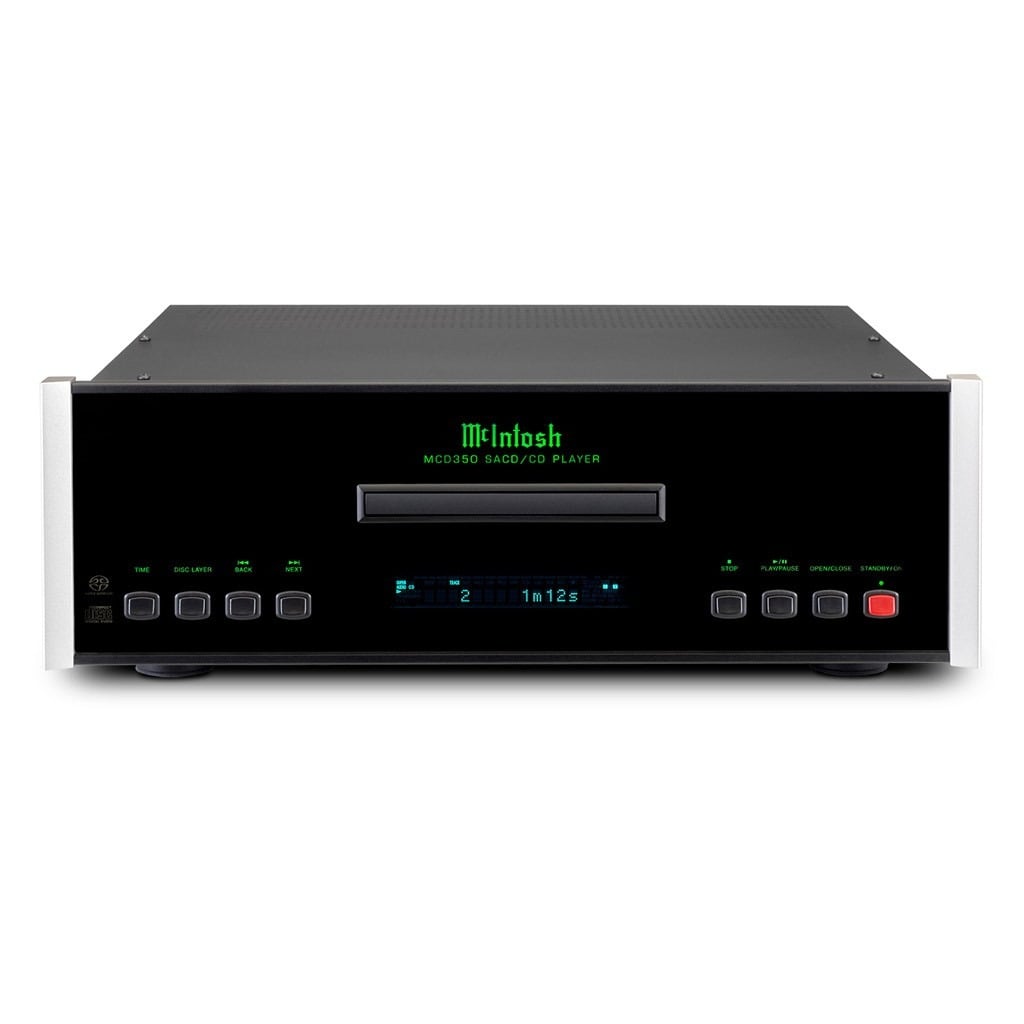
Questa macchina e in vero stile McIntosch , tanta classe e tanta sostanza e un suono davvero piacevole. Ora il modello 861 e stato sostiutito dal 871 che e la stessa macchina , ma con l'uscita HDMI per il video ad alta definizione.
La macchina e davvero notevole e suona molto molto bene in tutti i modi , sia con CD , SACD e DVD , io personalmente lo confrontato con il Maestro CD ultima versione e devo dire che ho trovato punti nei quali il Maestro risultava vincitore ed altri dove il McIntosh 861 svettava.
Dal sito : http://www.ultimateavmag.com/dvdplayers/605mc/
McIntosh ranks among the best-known names in high-end audio. Since the company's inception in the early 1950s, McIntosh products, with their immediately recognizable black-glass front panels, have earned a place in homes of passionate audiophiles throughout the world.
The latest McIntosh product to fall into my journalistic maw, the MVP 861 universal disc player, replaces the MVP 851 DVD-A player I reviewed about two years ago. This new machine represents McIntosh's first foray into the world of universal disc players. It can play CDs and DVDs as well as DVD-As, SACDs, CD-Rs, and CD-RWs with CD audio or MP3 files. With built-in decoders for SACD, DVD-Audio, Dolby Digital, and DTS, the MVP 861 delivers a one-box solution for all currently available audio and video disc formats.
The Core
The MVP 861 universal player looks much like McIntosh's previous MVP 851, but underneath its classic McIntosh exterior lurks a passel of new capabilities and components. According to McIntosh's Ron Cornelius, "The MVP 861 is a totally new design, although both players do share the same type of oversized R-core power supply and utilize PCM resolution at 24/192." The MVP 861 uses three pairs of the latest dual-mode PCM/DSD Burr Brown DACs. These can decode DSD data without any conversion to PCM. "SACD was a challenge for our design engineers," says Cornelius, "as the typical 1 to 3 percent THD+Noise at 10 KHz of most consumer SACD players was not acceptable. The MVP 861 will better this specification by 10 to 12dB."
The MVP 861's new video section supports both 480i and 480p outputs. The black level can be set to US or Japanese standards (for techies, that's either a 7.5IRE setup or no setup). European users will be pleased to learn that the MVP 861 also supports PAL playback. DVI and HDMI fans may be disappointed to find the MV 861 does not have either of these two digital-video outputs. Cornelius defends McIntosh's decision not to include these outputs, saying, "The current DVD players that change 480i native DVD to HDMI 720p or 1080i are all using the same popular video chipsets that generate video artifacts. Since the MVP 861 makes no attempt to manipulate the native 480i DVD video signal, it is free of macro-blocking, red push, white crush, and other side effects of upconversion caused by this chip set. McIntosh believes that premium display monitors are best left to rescale the picture with their specific built-in devices, since these match the actual pixel structure of the display."
(We must note here that all the DVI- or HDMI-equipped players we have tested to date will also put out digital video signals at 480p, leaving it to the display to upscale the signal as needed. One player, the Pioneer DV-59AVI, will even put out digital video at 480i.—TJN)
Regarding DVI and HDMI in McIntosh's future products, Cornelius concluded, "HDMI is a great connector, especially when we have the software to use it, which will be with HD DVD and Blu-ray discs. Until then, we do not see an advantage on DVD playback over good old flexible and inexpensive component cables."
Audio output options include both coaxial and TosLink digital outputs, single-ended RCA and balanced XLR stereo outputs, and single-ended RCA 5.1-channel surround outputs. Internal level and delay controls for the multichannel outputs can be adjusted via onscreen menus.
First Taste
Setting up the MVP 861 takes only a few minutes and can almost be accomplished without the aide of the instruction book. The onscreen menus give you access to all meaningful video adjustments including aspect ratio (including squeeze mode), display type (CRT, DLP, etc.), black level, and progressive output. Audio adjustments include speaker size, channel levels, delay times, digital output formats, 2-channel bass enhancement (sends bass info to the subwoofer as well as the main L/R speakers on 2-channel source material), and rudimentary bass management. A built-in test-tone signal makes setting individual channel levels easy, but adjustments can only be made in minus dB increments. This means you must first determine which speaker has the lowest output level and then lower the other levels to match it. Unlike the MVP 851, the 861 does not have the ability to remember settings for individual titles.
The MVP 861's remote control seemed very familiar to me since it is the same one used by Lexicon's MC-12 pre-pro. By necessity, Lexicon users need to develop a system to determine which remote is which. I constantly found myself adjusting the volume on the McIntosh's remote when I wanted to adjust the volume on the Lexicon. Silly me. Except for constant mix-ups, I found the McIntosh remote easy to use, since it does light up, and all the important functions can be found easily.
If you are the type of person who hates to wait for anything, you may notice some lethargy in the MVP 861's operations. While it takes the Lexicon RT-10 only 9.1 seconds to load a DVD and be ready for playback, the MVP 861 takes 14.1 seconds. Merely ejecting a disc takes the MVP 861 2.3 seconds, while the Lexicon RT-10 performs this function in 1.3 seconds. Once in top menu, both players get to a chapter selection in 1.2 seconds.
Full Meal
The MVP 861's audio and video quality certainly live up to McIntosh's reputation for stellar performance. Its 480p progressive output equals any player I've reviewed. Only the more expensive Meridian 598 DVD-A player and Lexicon RT-10 match the MVP 861's performance level. On test patterns from both Video Essentials and Avia test discs, the MVP 861 had sufficient acuity to resolve even the highest frequencies on the test patterns. The challenging Snell and Wilcox moving zone plate test also looked exceptionally clean from the MVP 861, with no sparkle or extraneous color and motion artifacts. The MVP 861 does exhibit a trace of stair-step edges on the fluttering American flag during the Video Essentials montage of images, and the slow pan across the stadium seats from the same segment exhibits only the very slightest bit of motion anomalies.
As you might expect, an outboard Faroudja Native Rate video processor produces a sharper picture since it outputs 720p, but the MVP 861 equals it in terms of motion rendering, color neutrality, and lack of decoding artifacts. Like the Meridian 598 and Lexicon RT-10 DVD players, the MVP 861's 480p performance exhibited little for me to fault. After several hours of going back and forth, I could not discern any meaningful differences in the picture quality between these three players. Perhaps the MVP 861 had a slight edge in motion-artifact control, but the Meridian's picture exhibited a smidgen less noise, and the Lexicon had a slightly more natural color palette. Bottom line, they all deliver an exceptionally high-quality 480p image.
As a player of CD, DVD-A, and SACD, the MVP 861 creates beautiful music. A/B listening sessions pitting it against the CEC TL-2 CD transport, Lexicon RT-10 universal player, and Meridian 598 DVD-A player left me with many pages of listening notes comprised of superlatives. Using their digital outputs for CD playback, all four players produced similar soundstage dimensions. The CEC TL-2 and Lexicon RT-10 had a slightly superior depth, but this may be a result of their AES/EBU digital outputs, which the other two units lack. Coupled to the Meridian 800 A/V processor, the Meridian 598 produces slightly more depth and realism on DVD-A sources, but the "home team advantage" of Meridian's digital upsampling and MHR (Meridian High Resolution) Smart Link connection may account for its supremacy. I suspect that if I had a McIntosh audio processor, the MVP 861 might reign supreme through an S/PDIF digital tether. When all things are nearly equal, as it is with these fine players, you can't discount the effects of synergistic component mating.
Using analog outputs, the MVP 861 produced sonically stellar results. Compared with the Lexicon RT-10's analog output, the MVP 861's more musical and slightly sweeter upper frequencies were immediately obvious. The Lexicon didn't sound bad by any means, but the McIntosh definitely delivered a less matter-of-fact harmonic balance that makes many imperfect commercial recordings sound better. On my own concert recordings, the McIntosh erred slightly on the side of euphony, but with conventional software, the McIntosh had a slight sonic edge. On Faith Hill's Cry (Warner Brothers 48001-9), a lush-sounding but overly compressed DVD-A recording, the MVP 861 seemed more compelling, but on the Grateful Dead's American Beauty (Warner Brothers/Rhino R9 74385), the Lexicon produced a more musically revealing result that may not have been as euphonic, but ultimately more satisfying for me.
DVD-As played through the Meridian 800 A/V processor using the analog outputs from both the McIntosh MVP 861 and Lexicon RT-10 paled in comparison to the Meridian 598 player's Smart Link connection, which keeps the DVD-A signal in the digital domain. The 598's superiority was not subtle. Through the Meridian combination, DVD-As sounded immediate, detailed, dimensionally palpable, and substantially more emotionally involving. After these listening sessions ended, I prayed to the audio gods that I may live long enough to see a time when all DVD-A players have digital connections for DVD-A playback.
On the venerable but still exceptional-sounding SACD release of Glenn Gould's Goldberg Variations (Sony Classical SS 37779), both the Lexicon RT-10 and McIntosh MVP 861 delivered a quiet noise floor that uncovers all of Gould's vocalizations. The McIntosh endowed Gould's Steinway piano with a smidgen more euphony, while it had a more metallic edge through the Lexicon. On Bob Dylan's Blood on the Tracks (Columbia CH 90323), "Buckets of Rain" had a more relaxed and natural ambience through the McIntosh, but the Lexicon preserved his last sigh at the end of the tune with a bit more resolution.
Last Mouthful
Why do audiophiles buy McIntosh components? Some choose McIntosh because of the unique and classic good looks, but most are swayed by the company's reputation for reliability and sonic excellence. The MVP 861 follows McIntosh's tradition of combining physical quality with fine performance. Some videophiles may be disappointed by the MVP 861's lack of digital video interfaces, but most will find its analog video performance more than compensatory. On currently available audio formats, the MVP 861 delivers a level of musicality and refinement that will satisfy any music lover.
"No one ever got fired for buying IBM" used to be business gospel. The audiophile parallel is, "No one was ever disappointed by a McIntosh audio component." The second truism still applies.
Di cosa si tratta: Multilettore DVD - SACD - CD
Produttore: McIntosh
Caratteristiche: Un vero multistandard
Prezzo da nuovo: 7600 € anno 2007 Audiocostruzioni di Sbisa' Giovanni e c snc e punto vendita McIntosh - Via Grosoli 6 - 41012 - Carpi MO - tel 059-685054- [email protected]
Specifiche
| PCM max | 24/192 |
|---|---|
| DSD max | DSD |
| DAC integrato | Burr Brown dual-mode PCM/DSD (tre coppie) |
| Uscite digitali | Coaxial, TosLink, RCA 5.1-channel surround |
| Meccanica CD | DVD-A, SACD, CD, CD-R, CD-RW |
| Anno produzione | 2004 |
| Paese di origine | USA |
| Ingressi digitali | No |
| Ingressi analogici | No |
Sul marchio
McIntosh Laboratory fu fondata nel 1949 da Frank H. McIntosh e Gordon Gow a Silver Spring, nel Maryland, e nel 1951 si trasferì a Binghamton, nello stato di New York, dove ha tuttora sede. Dal novembre 2024 il McIntosh Group, che comprende anche Sonus faber, appartiene all'americana Bose, che ha dichiarato di voler mantenere i due marchi concentrati su amplificatori, diffusori e giradischi.
La storia di McIntosh inizia con il circuito Unity Coupled, brevettato agli esordi dell'azienda e alla base del primo amplificatore, il 50W-1: una particolare configurazione del trasformatore d'uscita che riduceva la distorsione rispetto agli amplificatori dell'epoca e che è ancora oggi impiegata nei finali a valvole come l'MC275. Il design è inconfondibile: frontali in vetro nero, adottati dagli anni Sessanta, e i caratteristici VU meter illuminati di blu, presenti dalla metà degli anni Settanta. I trasformatori vengono ancora avvolti a mano all'interno dell'azienda.
Tra le soluzioni tecniche distintive ci sono gli Autoformer, gli autotrasformatori d'uscita impiegati in molti finali e integrati a stato solido, che permettono di erogare la piena potenza nominale su carichi da 2, 4 e 8 ohm; il Power Guard, circuito brevettato che confronta il segnale d'ingresso con quello d'uscita e limita il clipping; il Sentry Monitor, protezione senza fusibili che scollega lo stadio finale quando la corrente supera i limiti di sicurezza e ripristina automaticamente il funzionamento.
La gamma copre l'intera catena. Tra gli integrati ci sono l'MA252, primo integrato ibrido del marchio, con preamplificatore a valvole 12AX7 e 12AT7, finale a transistor da 100 watt su 8 ohm e uscita cuffie, e l'MA12000, ibrido da 350 watt per canale, oltre agli integrati a stato solido MA5300, MA7200, MA8950 e MA9500 e al valvolare MA2375. Il finale a valvole MC275 VI eroga 75 watt per canale con valvole KT88, oppure 150 watt in configurazione mono; i finali a stato solido vanno dall'MC152 al monofonico MC2.1KW da 2.000 watt. Completano la proposta i preamplificatori C22 MKV, C49, C55, C2800 e C12000, i lettori MCD85, MCD350, MCD600 e MCD12000, lo streamer DS200, l'amplificatore per cuffia MHA200, i giradischi MT2, MT5 e MT10 e i diffusori XR100, XRT1.1K, XRT2.1K e ML1 MK II.
La ML1 MK II riprende la ML1 progettata intorno al 1970 da Roger Russell: stesso mobile chiuso e stesse dimensioni, ma cinque altoparlanti invece di quattro, con un woofer da 12 pollici. Il giradischi MT5 usa un cuscinetto a sospensione magnetica, con contatto minimo tra le parti.
Chi cerca un solo apparecchio, con preamplificazione a valvole e gestione semplice, trova nell'MA252 il punto d'ingresso più naturale; con diffusori impegnativi o ambienti grandi gli integrati con Autoformer come l'MA8950, da 200 watt, o l'MA9500, da 300 watt, garantiscono la piena potenza su 2, 4 e 8 ohm. Chi preferisce la catena a componenti separati può abbinare un preamplificatore della serie C a un MC275 VI, ideale con diffusori di buona sensibilità, oppure a un finale a stato solido quando serve più potenza.
Nel nostro showroom di Carpi puoi ascoltare gli apparecchi McIntosh in sala d'ascolto, confrontarli con i tuoi diffusori e ricevere consulenza sull'abbinamento. Gli stessi modelli si possono ordinare online su audiocostruzioni.com con spedizione, chiedendoci prima un consiglio via email se serve.
Domande Frequenti
Questo prodotto si trova nella sezione Archivio, quindi non è più disponibile alla vendita. Visita il nostro catalogo per scoprire i modelli attuali oppure scrivici per ricevere consigli personalizzati su un prodotto equivalente.
Quando un modello esce di produzione, viene venduto definitivamente o non è più reperibile dai nostri fornitori, lo spostiamo nella sezione Archivio. Manteniamo la pagina online a scopo informativo: utenti e collezionisti possono continuare a consultare specifiche, descrizioni e immagini di riferimento.
Probabilmente sì. Visita il nostro catalogo prodotti per scoprire i modelli equivalenti attualmente in vendita: potrai filtrare per categoria, marca e fascia di prezzo per trovare l'alternativa più adatta al tuo impianto.
Non gestiamo prodotti usati o vintage. Per scoprire le alternative attualmente disponibili clicca sul pulsante "Vai al catalogo" in alto a destra della pagina, oppure vai direttamente al nostro catalogo prodotti per sfogliare i modelli in vendita.
Non gestiamo direttamente assistenza tecnica né ricambi. Nella nostra pagina supporto trovi le tabelle con i contatti diretti dei centri di assistenza e dei riparatori specializzati: puoi contattarli senza intermediari per valutare riparazioni o disponibilità ricambi.